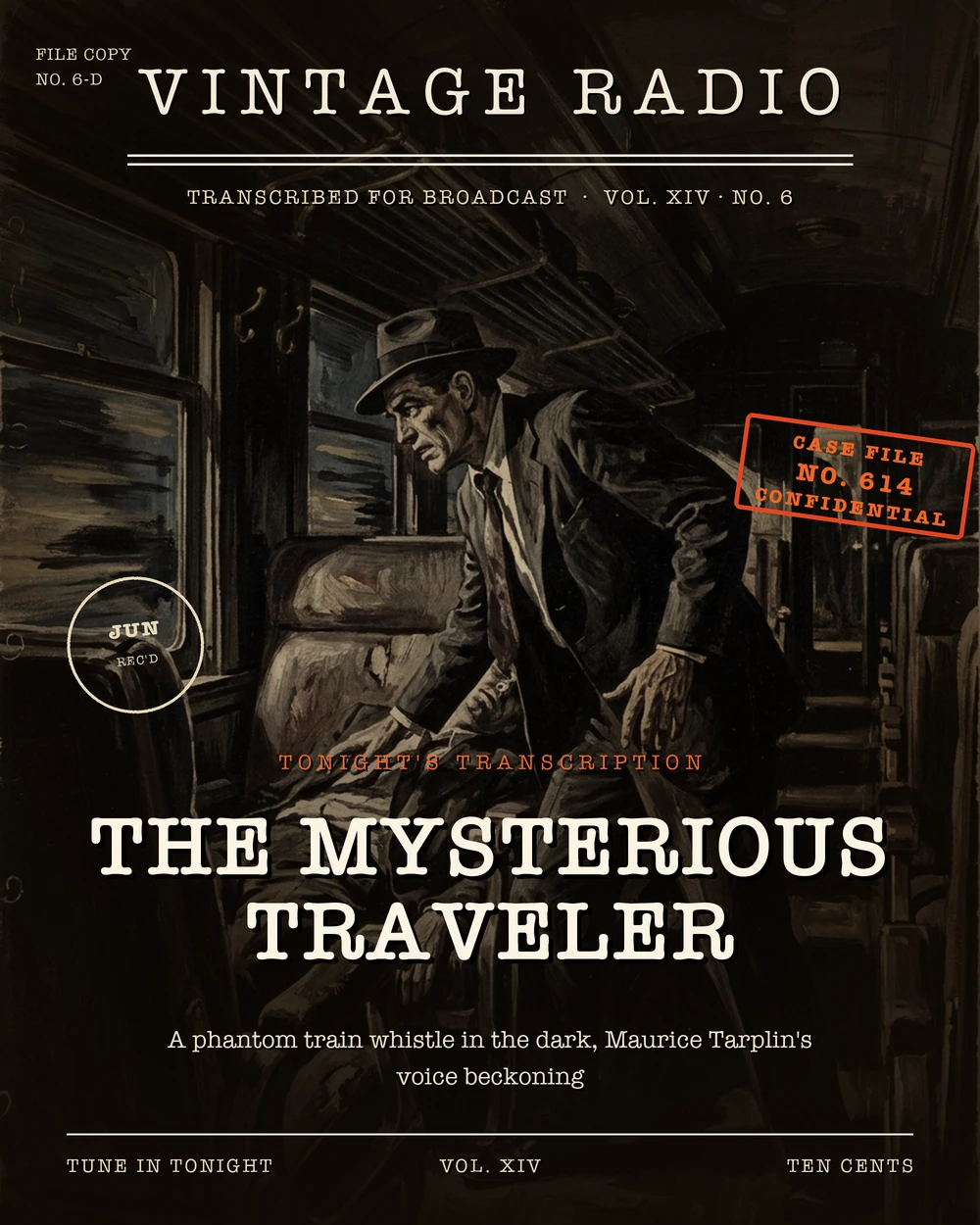
The Mysterious Traveler
The Train That Came in at Night
The Mysterious Traveler had one of the most effective opening signatures in all of radio. Out of silence came a distant locomotive wail — faint at first, then building until you could hear steel wheels clattering on steel rails — and then that voice. Maurice Tarplin, playing the nameless Traveler, would greet his audience: "This is The Mysterious Traveler, inviting you to join me on another journey into the strange and terrifying. I hope you will enjoy the trip, that it will thrill you a little and chill you a little. So settle back, get a good grip on your nerves, and be comfortable — if you can!"
It's easy to underestimate that kind of setup as a formula, but the formula worked because every element was doing real work. The phantom train was a genuinely eerie conceit — a narrator who existed on no timetable, in no geography, moving perpetually through the dark, picking up riders and eventually dropping them off whether they wanted to go or not. Each episode ended with the Traveler's gentle but inescapable farewell: "Oh, you have to get off here!... I'm sorry!... I'm sure we'll meet again... I take this same train every week at this same time..." And whatever scream had closed the story — somebody confronting something terrible — blended into the train whistle. It was a clean, elegant machine.
The show ran on Mutual from December 5, 1943 to September 16, 1952, working through thirty-minute episodes and surviving frequent timeslot changes, gaps between runs, and long stretches without a sponsor. At one time or another it aired on virtually every night of the week. The sponsorship record is genuinely mixed — most sources describe the show as sustained throughout, while others credit Adam Hats (which also sponsored the spin-off The Strange Dr. Weird) as the program's lone sponsor, and the discrepancy likely reflects shorter sponsored stretches inside a mostly unsponsored run. Either way, it was cheap to produce — no film stars, just New York radio actors willing to work for union scale — and that thriftiness, combined with the quality of the scripts and the indelible presence of Tarplin, kept it alive through circumstances that would have killed a more expensive production. Between 1944 and 1952, per Awake at Midnight, it became one of the sixteen highest-rated radio programs of its era.
The Writers Behind the Curtain
The Mysterious Traveler was the flagship creation of Robert Arthur Jr. and David Kogan, a writing partnership that met around 1940 as classmates studying radio production with Erik Barnouw at Columbia University. From 1942 to 1953, they worked together as producers, directors, and writers for the Mutual Broadcasting System in New York. The show was produced in collaboration with WOR, Mutual's New York flagship station, with Sherman "Jock" MacGregor serving as producer-director over the scripts Arthur and Kogan supplied.
The division of labor between them had a natural logic. Arthur had spent the 1930s writing for the pulp magazines — Wonder Stories, Weird Tales, Amazing Stories, Startling Stories, Unknown Worlds, and various Street & Smith mystery and detective titles — so the horror scripts were generally his territory. Kogan, who loved science fiction, tended to write the SF episodes, and he'd already established himself in radio before they met, having contributed to The Shadow and Bulldog Drummond. When Kogan described their process to radio historian Anthony Tollin roughly sixty years after the show ended, he explained that the partners spent one day a week developing a plot together, then one partner would draft the dialogue while the other rested.
The range of stories they produced together was genuinely wide. Science fiction episodes could go as far as a bug-hating scientist who concocted a formula to destroy all insect life, only to find the insects getting wise and coming after him. Horror episodes could go quieter and stranger, like a young couple haunted by the ghost of a woman murdered in their newly bought house in Vermont. Across an estimated 370 to 400 total scripts — sources vary, and the exact number is uncertain — Arthur and Kogan almost never ran out of ways to deliver the twist ending that the show's format demanded. Critic and mystery writer Anthony Boucher included Arthur's story "The Big Money" in his 1950 detective anthology Four-and-Twenty-Bloodhounds, taking the occasion to note with evident humor that even the show's co-creators didn't know the Traveler's true identity.
The Mystery Writers of America noticed the quality of what Arthur and Kogan were doing. The Mysterious Traveler was nominated for the Edgar Award for Best Radio Drama in 1949 and 1951, and eventually won the category outright in 1953. Their companion anthology Murder by Experts — a 1949–51 Mutual series that featured mystery writers John Dickson Carr and Brett Halliday as hosts — won the Best Radio Drama Edgar in 1950, and in 1951 the MWA honored both partners with a separate award for outstanding achievement in producing, directing, and writing radio mystery shows. Three Edgars total. The on-air acceptance of one of those awards actually survives in recorded form: at the end of Episode 46 of Murder by Experts, broadcast April 24, 1950, Kogan addressed the radio audience live. Only CBS's Suspense received more nominations in the Best Radio Drama category than The Mysterious Traveler.
The Voice of the Traveler
Several well-known New York radio actors auditioned for the title role, including Lon Clark, Lawson Zerbe, and Larry Haines, before Arthur and Kogan settled on Maurice Tarplin. It turned out to be an easy choice to stand behind. Tarplin had what was described as one of radio's eeriest voices — eerily sardonic, capable of conveying good-natured menace and a kind of mischievous malevolence. He stood outside the stories the way The Whistler did, the way Raymond stood outside the tales on Inner Sanctum Mysteries, offering commentary from what felt like an omniscient perspective lodged somewhere inside the soul of each protagonist. On a few exceptional episodes, the Traveler dropped that omniscient stance and played a character explicitly called "Dr. Smith," but the default was the pure narrative voice.
Tarplin was born in Boston on April 1, 1911, and attended Phillips Exeter Academy and Harvard before enrolling at the College of William and Mary, where he was on the championship ice hockey team. He arrived in New York in 1937 and started in daytime radio dramas. By 1942 he was playing Hercule Poirot on Murder Clinic, a short-lived Mutual mystery series, before The Mysterious Traveler came along and gave him the role he'd be identified with for the rest of his career. He was also Inspector Faraday on Boston Blackie, Dr. Weird on The Strange Dr. Weird, Richard Hanley on CBS's The Guiding Light in early 1951, and a member of The March of Time stock company, where his impersonation of Winston Churchill was frequently in demand. He appeared on The Shadow, Suspense, Gangbusters, Yours Truly Johnny Dollar, The Cavalcade of America, Counterspy, X-Minus One, and Exploring Tomorrow. In later years he did voiceover work for television commercials and provided English-language soundtrack translations for foreign films.
He also published exactly one piece of fiction: a short story in the June 1948 issue of Dime Mystery Magazine, titled "Seven Casks of Death" (cited in one source as "Seven Circles of Death"). Tarplin died on May 12, 1975, in Chappaqua, New York.
What the Show Could Do That Nothing Else Could
One episode stands above the others in the show's history. "Behind the Locked Door" was frequently requested and rerun over the years, and the reason isn't hard to understand once you hear what the episode actually does. Most of the story takes place inside a cave, in total darkness. Two archaeologists are trapped after a landslide, and in the dark they find remnants of an old wagon train, roughly a hundred years old. Then they're attacked by strange beings who are descendants of the original pioneers — living sightlessly underground, feeding on fish from an underground stream. The darkness isn't a backdrop; it's the story's entire atmosphere and logic. The episode simply could not have been made in any other medium, and the radio version demonstrates something that the best old-time radio writers understood: the absence of visuals isn't a limitation, it's a resource.
The supporting cast that populated episodes like this one came from New York radio's working depth. Beyond Tarplin, the recurring roster included Lyle Sudrow, Bryna Raeburn, Jackson Beck, Roger DeKoven, Bill Zuckert, Bill Johnstone, Lon Clark, Wendell Holmes, Jan Miner, Frank Readick, Joseph Julian, Elspeth Eric, Santos Ortega, Lawson Zerbe, and Ann Shepherd. Additional actors who appeared across the run included Everett Sloane, John McIntire, Tom Tully, Luis van Rooten, Larry Thor, Sam Edwards, Herb Vigran, Alan Reed (billed at the time as Teddy Bergman), Ed Begley, and Frank Lovejoy. Sound effects were handled by Jack Amrhein, Jim Goode, Ron Harper, Walt McDonough, and Al Schaffer. The crew was lean and experienced, which was exactly what the show needed.
A Franchise Beyond the Radio
The success of The Mysterious Traveler generated spin-offs almost immediately. Arthur and Kogan launched The Strange Dr. Weird for Mutual in 1944–45, a fifteen-minute Adam Hats-sponsored series featuring Tarplin again as a host narrator — now called Dr. Weird — which ran for 29 episodes; Jock MacGregor produced and directed it as well. That same year, 1945, they produced The Sealed Book for Mutual, this time in full thirty-minute episodes. The two spin-offs divided the material by flavor: The Strange Dr. Weird leaned toward the macabre and supernatural, The Sealed Book toward murder mystery. Both drew on scripts not just from The Mysterious Traveler but also from the earlier Arthur-Kogan series Dark Destiny, which they had produced for Mutual in 1942–43. Toward the end of the radio run, a good number of their Mysterious Traveler scripts were also recycled for episodes of Suspense on CBS.
The brand extended to print as well. Arthur and Kogan launched The Mysterious Traveler Magazine in November 1951, with Kogan as publisher and Arthur as managing editor. Grace Publishing put out five issues, from November 1951 through September 1952, each with a cover painted by pulp illustrator Norman Saunders. The table of contents across those five issues reads like a best-of anthology: fiction by John Dickson Carr, Dorothy L. Sayers, Brett Halliday, Agatha Christie, William Hope Hodgson, and Ray Bradbury. Bradbury's "The Wind" appeared in the first issue and was later collected in his 1955 book The October Country; "To the Future" ran in the second issue; "The Crowd" appeared in the final issue.
Comics followed. Trans-World Publications put out Mysterious Traveler Comics #1 in November 1948, which adapted the radio script "Five Miles Down" as a comics story. Charlton Comics published Tales of the Mysterious Traveler for 13 issues from 1956 to 1959, with Steve Ditko illustrating many of the stories, then revived the title with two more issues in 1985, shortly before Charlton ceased operations. Stories that had been prepared for further Charlton issues later appeared in Renegade Press's Murder comic. In 1990, Eclipse Comics collected 19 Ditko stories from the Charlton run in a large-format paperback; Fantagraphics later published the same body of work — over 210 full-color pages — in Mysterious Traveler: The Steve Ditko Archives Vol. 3 in 2012.
Harlan Ellison, writing in 1981, recalled a childhood encounter with what he identified as the "Five Miles Down" episode. In 2004, Ellison participated in a recreation of that script at a convention of the Society to Preserve and Encourage Radio Drama, Variety and Comedy, where he both acted in and helped direct the show.
How It Ended
The cancellation in September 1952 had nothing to do with ratings or quality. Both Arthur and Kogan were active members of the Radio Writers Guild, which the House Un-American Activities Committee designated a "Communist front organization" in 1952. An article in Broadcasting Telecasting in early September 1952, titled "'Red' Probe; More Details Expected," specifically named Kogan. Pressure from advertisers and WOR affiliates on the Mutual Network followed, and the show ended.
What happened to the two men afterward diverged sharply. Arthur went on to write scripts for Alfred Hitchcock Presents and The Twilight Zone, and ghost-edited numerous Alfred Hitchcock-credited mystery anthologies. Kogan eventually became a portfolio manager in Philadelphia. Arthur died there on May 2, 1969, and was interred at West Laurel Hill Cemetery in Bala Cynwyd, Pennsylvania. Kogan lived until August 6, 2009, dying in Maine at the age of 93.
Kogan's son Kenneth donated his father's papers — scripts, indexes, and correspondence about the blacklisting experience, approximately 350 items in two boxes — to the Library of Congress in May 2010. They're held at the Recorded Sound Research Center and were processed by archivist David Jackson in 2019.
Of the estimated 370 to 400 episodes produced across the run, somewhere between 70 and 80 survive — sources give figures ranging from "about 70" to "75 to 80." The surviving episodes are in public-domain status; the US Copyright Office confirmed that the show's copyright expired and was never renewed. A certified accurate set of the surviving episodes was released, most recently updated to Version 2 in January 2020. A brief television version of the show also existed, though radio historian Jim Grams notes it was not considered as frightening or successful as the radio original — which is about what you'd expect from a show whose greatest episode was built entirely around darkness.